
How Telegram Trading Groups and Online Marketplaces are Revolutionizing Digital Goods Promotion and Buy-Sell Communities
Authored by freebet.icu, 08 Feb 2026
Most people still associate digital commerce with polished storefronts, checkout flows, and platform fees that quietly erode margins. But a parallel economy has been growing inside a messaging app, and it operates by entirely different rules. Telegram has become one of the most active environments for buying and selling digital goods - not because it was designed as a marketplace, but because its architecture accidentally created the perfect conditions for one. Large group capacity, fast messaging, bot integration, and a global user base with no geographic restrictions turned what was meant to be a communication tool into a functioning trading infrastructure used by hundreds of thousands of people daily.
The communities forming inside this infrastructure range from small niche groups trading specialized software licenses to large-scale channels with tens of thousands of active members transacting across multiple digital product categories. For anyone trying to understand how this ecosystem works - whether as a buyer looking for deals, a seller seeking new distribution channels, or simply someone trying to make sense of where digital commerce is heading - the landscape can appear opaque at first. Platforms that catalog and organize this activity, such as the buy sell telegram channels marketplace, offer a structured entry point into what would otherwise require significant independent research to map.
This article explains how Telegram-based trading communities are structured, what digital goods move through them, how sellers build effective promotional strategies, what risks exist and how to manage them, and how to identify and join communities worth your time. It also looks at where this space is heading as the technology and user behavior around it continue to mature.
What Are Telegram Trading Groups and Why Are They Growing So Fast?
Telegram trading groups are organized communities - open or invite-only - where members buy, sell, and exchange digital goods directly within the platform. Unlike general social media spaces where commerce is incidental, these groups are built around specific product categories or transaction types from the ground up. Their membership is purposeful: everyone present is there because they have something to sell, something to buy, or both.
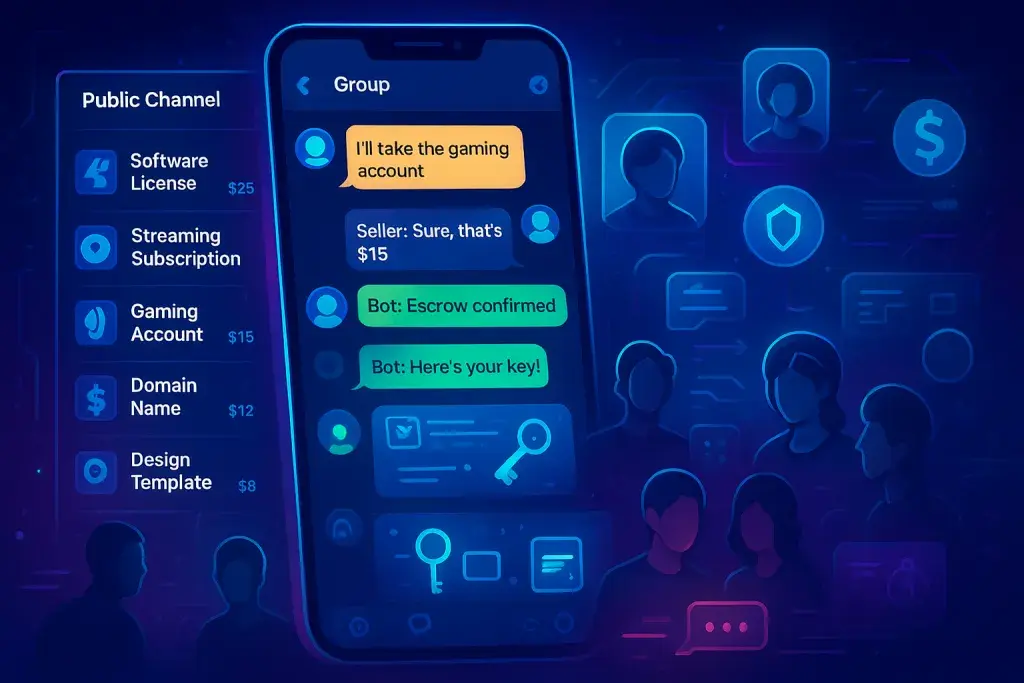
What makes Telegram particularly well suited to this role is a combination of structural features that no other mainstream messaging platform offers at the same scale. Groups support up to 200,000 members. Channels allow unlimited subscribers and one-way broadcasting. Bots can handle automated order processing, payment confirmation, and product delivery. Pinned messages serve as persistent product catalogues. None of these features require a third-party plugin or a paid plan - they are built into the platform and available to anyone.
The appeal for digital goods specifically comes down to delivery mechanics. A software key, a subscription credential, or a digital file can be sent via chat in seconds after payment is confirmed. There is no shipping, no warehousing, no logistics. The transaction arc from listing to delivery can complete in under five minutes, which is faster than almost any traditional e-commerce flow. That speed, combined with direct buyer-seller communication, creates a sense of transactional immediacy that platforms built on formal checkout systems cannot easily replicate.
Growth in these communities also reflects a broader shift in how trust operates in digital commerce. Buyers have grown skeptical of faceless platforms with opaque seller vetting. In well-run telegram trading groups, reputation is visible, moderation is active, and community members collectively police quality. That social accountability mechanism - informal but real - has proven more effective at building transactional confidence than many formal platform guarantee systems.
- Group and channel member limits that accommodate large-scale trading communities without platform costs
- Bot integration for automated order handling, payment verification, and digital product delivery
- Pinned posts and searchable message history functioning as persistent product catalogues
- Real-time communication that accelerates trust-building between buyers and sellers
- Cross-device availability keeping communities continuously active across time zones
- Anonymous participation options that appeal to privacy-conscious traders
The communities that have attracted the largest and most active memberships are not simply chat rooms with loose trading activity. They operate with written rules, defined seller verification processes, moderation hierarchies, and structured dispute resolution. That organizational maturity is what separates functioning marketplaces from chaotic group chats - and it is the primary reason serious digital goods traders continue to migrate toward Telegram-based buy sell communities rather than away from them.
The Structure of Online Marketplace Channels on Telegram
Understanding how Telegram trading communities are architected is essential before participating in them, because structure directly determines how trust is established and how transactions are safely completed. The platform offers two distinct formats - channels and groups - and the most sophisticated trading operations use both together.
Channels vs. Groups: Key Differences for Traders
Channels are one-way broadcast tools. Only administrators can post, which means the content is controlled, consistent, and easy to scan. For sellers, a channel is the equivalent of a digital storefront window: product listings, pricing updates, and promotional announcements reach subscribers without competing with member chatter. For buyers, channels provide a clean, reliable feed of available products from a known source.
Groups enable two-way communication among all members, making them better suited to negotiation, product questions, community vetting, and general deal-making. A buyer who wants to verify a seller's reputation before committing can ask the group directly. A seller who wants to address objections in real time can do so publicly, building credibility with the entire audience simultaneously.
The most effective online marketplace channels combine both formats: a channel for listings, linked to a group for member interaction. This separation maintains clarity in the product feed while preserving the community dynamic that makes Telegram trading trustworthy.
| Feature | Telegram Channel | Telegram Group |
|---|---|---|
| Who can post | Admins only | All members (subject to rules) |
| Member capacity | Unlimited subscribers | Up to 200,000 members |
| Primary use case | Product listings and announcements | Negotiation and community trust-building |
| Discoverability | Public channels searchable by name | Public or private, admin-controlled |
| Bot integration | Supported | Fully supported |
Admin Roles, Verification Systems, and Trust Layers
In any well-run trading community, administrators are the backbone of the operation. They vet sellers before granting posting privileges, monitor transactions for fraud patterns, remove bad actors, and maintain the group's overall reputation. The quality of a community's admin team is often the single best predictor of how safely and efficiently transactions occur within it.
Verification systems vary in sophistication. Some communities require new sellers to submit proof of product legitimacy, provide references from other platforms, or complete an initial supervised transaction. Others issue tiered seller badges based on completed transaction counts and feedback scores. These visible trust signals allow buyers to make faster, more confident purchasing decisions without needing to independently investigate every seller they encounter.
Telegram bots play an increasingly important role in automating trust infrastructure. Bots can run background checks on new members, track seller reputation scores, process payments, deliver digital goods upon confirmed payment, and collect post-transaction feedback - all without manual admin input. For large communities handling hundreds of daily transactions, this automation is not optional; it is operationally necessary.
Niche Communities vs. General Marketplaces
General marketplace channels cast a wide net. They list diverse product categories and attract broad audiences, which produces volume but often sacrifices depth. Buyer-seller alignment is inconsistent because a member interested in gaming assets and a member looking for design templates are fundamentally different audiences whose needs rarely overlap.
Niche communities organized around a specific product category - software licenses, streaming subscriptions, social media accounts, or digital creative assets - attract members who arrive with shared context and aligned expectations. Sellers in these environments can speak to their audience's specific concerns without explanation. Buyers can evaluate listings with product-specific knowledge rather than general skepticism. Transaction success rates in tightly focused buy sell communities tend to be meaningfully higher as a result.
For new participants in digital goods telegram trading, the practical implication is clear: find the community that most precisely matches your product category rather than defaulting to the largest general marketplace available. Volume is less valuable than fit.
Digital Goods on Telegram: What's Being Traded and How
The range of digital products moving through Telegram trading communities is broader than most outsiders realize. While software keys and subscription accounts are the most widely recognized categories, active trading occurs across nearly every segment of the digital goods market - and each category comes with its own conventions, pricing norms, and delivery expectations.
Most Common Digital Product Categories
Software licenses and activation keys represent one of the highest-volume categories. Demand is consistent, delivery is straightforward - a key delivered by message - and the product authenticity is verifiable by the buyer before any money changes hands. This combination of high demand and simple verification makes software keys a foundational product category in most digital goods telegram communities.
Streaming and subscription account access is another large segment, though one that carries more complexity. The ethics and legality of account trading depend heavily on what is being sold, how the account was obtained, and the terms of service of the platform in question. Buyers in this category need to apply more due diligence than in others.
Beyond these two dominant categories, active trading occurs across a wide range of digital product types:
- Social media accounts across major platforms
- Telegram channels and established group memberships
- Domain names and web-based assets
- Design templates, stock photography, and creative production assets
- Gaming items, in-game currencies, and gaming accounts
- E-books, video courses, and packaged information products
- VPN and security tool subscriptions
Delivery Methods and Transaction Workflows
The transactional advantage of digital goods is that the product travels at the speed of a message. Once a buyer confirms payment, a seller can deliver a license key, credential, or file instantly through the chat interface. No courier, no tracking number, no waiting period. This immediacy is one of the core reasons trading communities built around digital goods have grown faster on Telegram than communities focused on physical products.
Most organized trading groups follow a recognizable workflow that balances speed with basic security:
- Seller posts a product listing in the designated channel or group with full product details and pricing
- Buyer reviews the listing and contacts the seller directly or through a community bot
- Both parties confirm product specifications, price, and payment method
- Payment is made - either directly to the seller or held in a community-endorsed escrow account
- Seller delivers the digital product via direct message, file attachment, or automated bot
- Buyer tests and confirms the product's validity and functionality
- Escrow releases payment to the seller upon confirmed delivery, if escrow was used
Communities that have automated steps four through seven using Telegram bots achieve the highest transaction throughput because they eliminate the coordination delays that slow down manual processes. Buyers experience faster delivery; sellers spend less time on logistics and more time on product sourcing and listing.
Pricing Norms and Market Dynamics
Pricing in Telegram buy sell communities is shaped by real-time market visibility. Because comparable listings from multiple sellers are visible to all group members simultaneously, price discovery happens quickly and informally. Sellers who price above community norms will see their listings scroll past without engagement. Sellers who price competitively and pair that with strong reputation signals generate consistent transaction volume.
Cryptocurrency dominates as the preferred payment method across digital goods telegram communities. Stablecoins offer price stability that suits both parties; Bitcoin and Ethereum provide global accessibility. The irreversibility of confirmed blockchain transactions is a significant factor in their adoption - sellers are protected from chargeback fraud in a way that card-based payment systems do not provide. Some communities also accept peer-to-peer digital wallet transfers, particularly where membership skews toward regions with high mobile payment adoption.
Marketplace Promotion on Telegram: Strategies That Actually Work
Joining a trading group does not automatically produce sales. The sellers generating consistent revenue in these communities have developed deliberate approaches to marketplace promotion on Telegram - approaches that respect how these communities function and what their members actually value. The gap between a seller who posts occasionally and gets ignored and one who consistently moves product at scale is almost entirely explained by strategic differences, not product quality differences.
Building Credibility Before Promoting
Reputation in Telegram trading communities precedes every transaction. Buyers in established groups have seen enough bad actors to treat unknown sellers with default skepticism. Arriving in a community with zero transaction history and immediately posting high-ticket listings is a pattern that experienced buyers recognize immediately as suspicious - regardless of whether the seller's products are legitimate.
The productive alternative is to participate in the community genuinely before promoting aggressively. Answering buyer questions, contributing relevant knowledge, completing a few small verified transactions to build an initial feedback record, and going through any seller vetting process the community requires - these steps take time but produce a credibility foundation that no amount of promotional content can substitute for.
Experienced community members also note that sellers who engage with the community rather than simply broadcasting at it tend to accumulate repeat buyers faster. The relationship dimension of Telegram trading is not incidental; it is structural. People buy from sellers they recognize.
Crafting High-Converting Listings
A product listing in a Telegram group competes for attention in a real-time feed. Members scroll quickly. Listings that fail to communicate their core value proposition within the first two lines lose the reader before the price is even seen. High-performing listings lead with the specific product, its immediate benefit or key specification, and the price - in that order.
Complete listings include several elements that consistently correlate with higher buyer confidence: a precise product description with no ambiguity about what is included, clear pricing with no hidden costs, explicit delivery timeframe, a stated replacement or refund policy, and accessible social proof such as links to a public feedback thread. Sellers who omit these elements and rely on buyers to ask questions add friction to the purchasing process and lose sales to sellers who do not.
Formatting discipline matters more on Telegram than on most platforms because messages are read in motion. Short paragraphs, clear section breaks, and concise bullet points significantly outperform dense text blocks in engagement. Pinned posts, reaction polling, and scheduled reposts are additional tools that allow sellers to maintain listing visibility without generating the spam behavior that gets accounts banned.
Using Bots and Automation for Scale
A seller handling ten transactions per day can manage manually. A seller handling a hundred cannot - not without automation. Telegram's bot ecosystem allows sellers to build order-handling systems that accept inquiries, confirm payment, deliver products, and collect feedback without requiring the seller to be present for each interaction.
Custom bots built around a seller's specific product catalogue can handle the entire post-listing transaction flow. Buyers interact with the bot, confirm their order, make payment, and receive their digital product - all within a single conversation thread. The seller's role shrinks to sourcing products, maintaining inventory, and managing edge cases that automation cannot resolve.
Many established online marketplace channels have deployed community-wide bot infrastructure that verified sellers can connect to, rather than requiring every seller to build their own system. This shared infrastructure lowers the technical barrier for new sellers while maintaining consistent transaction standards across the entire community.
Cross-Promotion and Multi-Channel Strategy
Sellers who concentrate all their activity in a single community accept unnecessary risk. If that community's activity slows, its admin team changes, or its rules shift unfavorably, the seller's entire distribution disappears overnight. Building presence across multiple related buy sell communities creates resilience - and because Telegram channels require no listing fees, the cost of maintaining multiple presences is primarily time rather than money.
Effective cross-promotion requires adapting to each community's norms rather than mass-posting identical content across groups. Communities develop distinct cultures, vocabulary preferences, and posting standards. Sellers who treat every group as interchangeable and blast the same message across all of them are identified as spammers quickly and banned accordingly. Sellers who tailor their approach to each community's specific character while maintaining a consistent product identity and brand voice build durable multi-channel businesses that compound over time.
Risks, Scams, and How to Protect Yourself in Buy-Sell Communities
The same qualities that make Telegram trading attractive - speed, low friction, pseudonymity - also create the conditions that fraudsters prefer. Scams exist in every trading community, and the question is not whether they occur but whether a participant's habits and judgment minimize exposure to them. Both buyers and sellers face distinct but real fraud risks that require specific countermeasures.
Common Scam Patterns to Recognize
The most straightforward scam is also the most common: a seller collects payment and then blocks the buyer without delivering the product. Variations include delivering a product that has already been used or is otherwise non-functional, and impersonation scams where a fraudster copies a reputable seller's display name and profile image to intercept buyers who are trying to reach the legitimate seller.
Fake escrow scams are particularly damaging because they target buyers who are already trying to protect themselves. A fraudster poses as a neutral escrow intermediary, collects funds from the buyer, and disappears before the transaction completes. Buyers who use community-official escrow services rather than agreeing to escrow arrangements proposed by unknown parties avoid this pattern almost entirely.
Sellers are not immune. Chargeback fraud - where a buyer reverses a payment through a dispute process after receiving the digital goods - is a meaningful risk when reversible payment methods are used. Coordinated false-reporting attacks, where a group of bad actors mass-reports a legitimate seller to trigger an automated ban, are less common but do occur in competitive niches.
- Pay-and-disappear: payment collected, product never delivered, seller blocks buyer
- Non-functional delivery: product delivered but already redeemed, expired, or invalid
- Impersonation: fraudster mimics a trusted seller's username and profile image
- Fake escrow: scammer poses as neutral intermediary and disappears with buyer's funds
- Chargeback fraud: buyer disputes reversible payment after receiving digital goods
- False reporting: coordinated mass-reports designed to get legitimate sellers banned
Practical Safety Measures for Buyers and Sellers
For buyers, the most reliable protective habits are verification and patience. Checking a seller's reputation score within the community before any transaction, verifying the seller's username against the community's official verified seller list, and starting with a small test purchase before committing to a large one - these steps eliminate the vast majority of scam exposure. Using community-endorsed escrow for high-value transactions adds a structural layer of protection that individual judgment alone cannot provide.
For sellers, the key protections are payment method selection and documentation. Accepting only irreversible payment forms for digital goods eliminates chargeback risk entirely. Keeping detailed records of every transaction - including payment confirmation screenshots and delivery proof - provides a defense against false dispute claims. Building reputation gradually before scaling transaction volume reduces exposure to the coordinated attacks that disproportionately target high-visibility sellers.
| Risk Type | Primary Target | Recommended Prevention |
|---|---|---|
| Pay-and-disappear | Buyers | Use community escrow; verify seller reputation before payment |
| Non-functional delivery | Buyers | Request proof of product validity before releasing payment |
| Impersonation | Both parties | Cross-check usernames against official community verified seller lists |
| Fake escrow | Buyers | Use only escrow services endorsed by community admins |
| Chargeback fraud | Sellers | Accept irreversible payment methods only; document all transactions |
How to Find, Evaluate, and Join the Right Trading Communities
With large numbers of trading groups and channels operating on Telegram at any given time, selecting communities worth joining requires a deliberate evaluation process. The quality difference between a well-run trading community and a poorly moderated one is not cosmetic - it directly determines transaction safety, product quality, and the value a participant can extract from membership. Choosing carefully at the outset saves significant time and potential losses later.
Where to Discover Active Trading Groups
Telegram's internal search function is the most accessible discovery tool, but it returns results without quality filtering. A search for a product category will surface active communities alongside inactive ones, legitimate marketplaces alongside scam operations, and established groups alongside newly created ones with no track record. Using it as a starting point is reasonable; using it as the only research method is not.
More reliable discovery routes include curated directory websites that catalogue and rate Telegram trading communities by category, referrals from trusted participants who are already active in these markets, and dedicated marketplace platforms that aggregate and organize channel and group listings. Referrals from people with direct experience in a specific community consistently outperform search-based discovery in terms of community quality.
Evaluating Community Quality Before Joining
Raw member count is the least reliable quality signal in Telegram trading. Subscriber numbers can be inflated through purchased followers, inactive accounts, or historical membership that predates a community's decline in quality. Engagement rate - the ratio of active participation to total membership - is a far more meaningful indicator of a community's genuine health.
Several characteristics consistently distinguish high-quality trading communities from low-quality ones:
- Clearly written community rules, prominently posted and visibly enforced
- Regular moderation activity including public announcements when bad actors are removed
- A functional seller reputation system with visible scores, badges, or verified seller designations
- Organized channel structure that separates product listings from general discussion
- High engagement relative to membership size, with genuine buyer-seller interaction
- Responsive and accessible admin team available for dispute resolution
- Established operating history with consistent posting activity over time
Building Your Own Trading Community vs. Joining Existing Ones
Creating a personal Telegram channel or group is a strategic option that makes sense at a specific stage of a seller's development - but not at the beginning. Building an audience from zero requires sustained effort in promotion, content consistency, moderation, and community management before the channel generates meaningful transaction volume. Most sellers who launch channels too early find themselves maintaining an empty room while ignoring the larger and more active communities where their buyers already spend time.
The practical path for most sellers is to build reputation within established communities first, develop a base of repeat buyers who know and trust them personally, and then launch a dedicated channel as a supplementary distribution point for that existing audience. Sellers who approach personal channel building this way - as an expansion of an established presence rather than a cold start - consistently achieve better results than those who attempt to build from scratch before earning community credibility.
The Future of Telegram Trading Groups and Digital Commerce Communities
The trajectory of Telegram-based trading communities points toward greater operational sophistication, broader adoption among mainstream digital goods sellers, and deeper integration with adjacent financial and automation technologies. Several developments are already reshaping the ecosystem in ways that suggest this form of commerce is in an early phase of its maturation rather than approaching a ceiling.
Telegram's ongoing platform development - including expanded payment API capabilities, improved channel monetization tools, and increasingly powerful bot frameworks - is steadily reducing the gap between what a Telegram-based trading operation can do and what a standalone e-commerce platform offers. In some product niches, Telegram communities already provide a faster, more personalized, and lower-cost buying experience than traditional platforms. As native platform tools continue improving, that advantage will extend to more categories.
The integration of cryptocurrency payment infrastructure with Telegram bots is another significant development with practical consequences. Automated escrow systems built on smart contracts, on-chain reputation scoring, and bot-enforced delivery conditions are moving from experimental implementations to practical tools available to any community operator. These mechanisms directly address the trust and fraud challenges that currently create friction in high-value transactions, and their broader adoption would meaningfully expand the ceiling for transaction sizes that the ecosystem can reliably support.
Regulatory attention on peer-to-peer digital goods trading is increasing in multiple jurisdictions. This creates compliance complexity for some community operators and participants, but it also creates a competitive opportunity for communities that invest in transparent practices, clear terms, and consistent enforcement. Communities that build institutional legitimacy now - through rigorous seller vetting, documented dispute resolution processes, and compliance-aware operating standards - will be better positioned to attract the kind of high-value participants who currently hesitate to engage with less structured environments.
The digital goods telegram trading ecosystem is not a passing experiment. The communities that lead its next phase of development will be those that treat their groups as durable market institutions rather than temporary aggregations of opportunistic transactions - and that investment in community quality will compound into sustainable competitive advantages as the overall market continues to grow.
Questions and Answers
How do I verify that a seller in a Telegram trading group is legitimate before making a payment?
Cross-reference the seller's username against the community's official verified seller list, which reputable groups maintain as a pinned post or bot-accessible registry. Check their feedback thread or reputation score within the community, and look at transaction history length - sellers with hundreds of completed transactions over an extended period carry significantly more credibility than newly registered accounts. For any transaction above a modest amount, use the community's endorsed escrow service rather than paying directly.
What should I do if I get scammed in a digital goods Telegram community?
Report the incident to the group's admin team immediately with screenshots documenting the full conversation, payment confirmation, and any delivery attempt or failure. Well-run communities track scammer reports and can block accounts, warn other members, and in some cases assist with recovery through escrow systems. If you paid via cryptocurrency, recovery is generally not possible through payment reversal, which is why escrow use and pre-transaction verification are the only reliable protections - remediation after the fact has very limited options.
Is it possible to run a profitable operation selling digital goods through Telegram channels without building a large following first?
Yes, by joining established buy sell communities with active memberships rather than trying to build an audience from zero. Established groups give you immediate access to buyers who are already in purchase mode. The limiting factor is not audience size but seller reputation - a new seller with no feedback record in a community will convert at lower rates regardless of product quality, which is why completing early transactions at lower margins to build a verifiable history is a standard practice among successful Telegram sellers.
What types of digital products are genuinely safe to buy and sell through Telegram trading groups?
Products where ownership and licensing rights are clear and transferable carry the lowest risk: original software licenses obtained through legitimate channels, digital creative assets produced by the seller, domain names, and information products like courses or templates that the seller created or holds resale rights to. Categories where account access or platform terms of service are involved - streaming subscriptions, social media accounts - carry higher ethical and legal complexity that varies by platform and jurisdiction, and buyers in those categories should research the specific platform's policies before transacting.
How do Telegram marketplace communities handle disputes between buyers and sellers?
Dispute handling depends entirely on how the specific community is structured. Well-organized groups designate admin team members as mediators, require both parties to submit documented evidence, and render decisions based on community rules. Outcomes typically include refunds, replacements, or seller reputation penalties. Communities that use bot-based escrow can resolve disputes more cleanly because funds are held in neutral custody until delivery is confirmed, removing the need to recover money that has already transferred. Groups with no formal dispute process offer essentially no protection, which is a clear signal to avoid them for anything beyond minimal-value transactions.