
Faso and Öçal Stun Second Seeds Chirita and Istrate to Reach Quarterfinal
Authored by freebet.icu, 19 Jun 2026
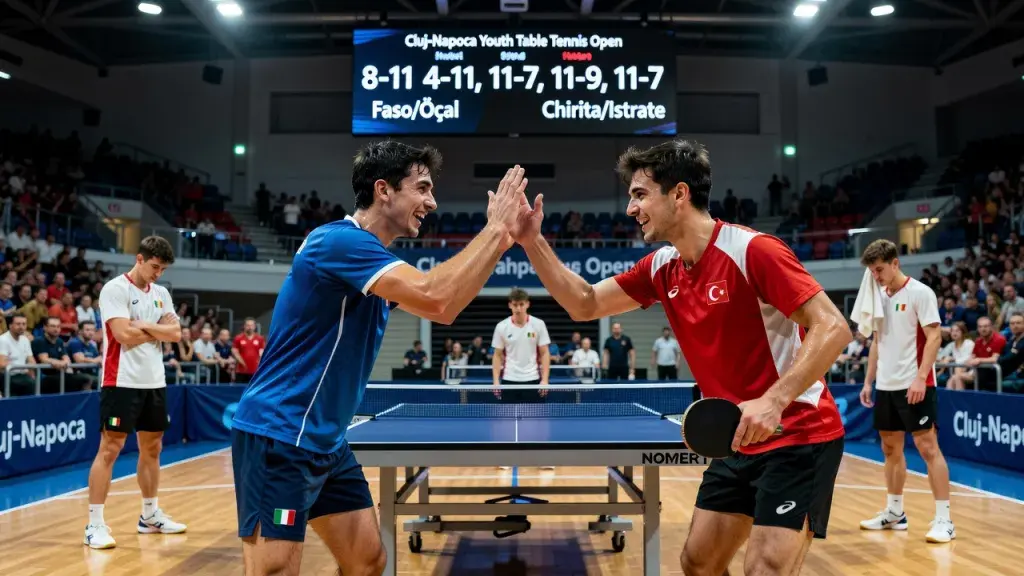
A partnership assembled just six weeks ago produced one of the standout upsets of the doubles competition in Cluj-Napoca, as Italy's Danilo Faso and Türkiye's Görkem Öçal overturned a two-game deficit to eliminate second-seeded Romanians Iulian Chirita and Andrei Istrate 3-2. The scoreline - 8-11, 4-11, 11-7, 11-9, 11-7 - tells the story of a match that swung decisively in the second half, driven by character as much as technique. The new pairing now advances to the quarterfinal, where a genuine shot at a medal awaits.
The sheer novelty of the partnership makes the result all the more remarkable. Faso and Öçal only agreed to play together roughly a month and a half before the tournament, at Öçal's initiative. In a competition where established duos with shared match experience and practiced chemistry typically hold the edge over hastily formed alliances - not unlike how a late-card addition can shift the odds in a bkfc bet - the two youngsters confounded expectations by finding cohesion under serious pressure. "We decided to play together about a month and a half ago. Görkem asked me and I said yes, I would like to. Now we are very happy because we are doing very well," said Faso.
Going into the match, neither player was naive about the difficulty of the draw. Chirita and Istrate carried the weight of the second seeding and the added motivation of performing on home soil in Romania. "When we saw the draw, we were not very happy, but before the match we were very focused. We wanted to beat them because after that we would have a chance to fight for medals," Faso admitted. That clarity of purpose proved crucial when the opening two games went badly - 8-11 and 4-11 - and the match seemed to be slipping away.
A Comeback Built on Communication
What separated Faso and Öçal in the defining moments was not a tactical adjustment so much as a human one. Trailing 0-2 and well below their own standards, the pair turned to each other rather than retreating into frustration. "We were 2-0 down and we were not playing at our level. They were playing well, but we were not playing very well. Then we started to tell each other, 'Come on, we can do it, we have to fight for this match,'" said Öçal. The results of that exchange were immediate: three consecutive games won at 11-7, 11-9 and 11-7, each opened with a strong early lead that steadied their nerves and ultimately broke Romanian resistance. "We started very well in each of the next games, leading 3-0, and that helped a lot," Öçal added.
Rivals Turned Partners - A Story Already Rich in History
The subplot running through this result is the relationship between the two players themselves. At the European Youth Championships the previous year, Faso and Öçal met not once but three times - in the Under 15 Singles final, the Doubles final, and the Team event final between Italy and Türkiye. Faso won all three encounters. That record of competitive intensity between them gives their current alliance a particular texture: these are not strangers pooling resources, but two athletes who know each other's games in fine detail, forged through some of the most consequential matches of their young careers. That shared history may well be one of the hidden strengths of their partnership - an intimate understanding of tendencies, strengths, and pressure responses that no amount of practice sessions alone can manufacture.
What the Result Means Going Forward
For the host nation, the exit of the second-seeded Romanian pair is a significant blow. Chirita and Istrate would have represented a genuine medal hope on home ground, and their elimination removes one of the more credible domestic narratives from the competition. For Faso and Öçal, the quarterfinal is already an achievement that surpasses most pre-tournament expectations for a newly formed pair, but neither player appears satisfied with simply reaching this stage. The medal ambition Faso articulated before the match was not rhetoric - it is now a live possibility. How the pair manage the emotional and physical demands of the knockout rounds, with no established rhythm of previous tournaments together to draw on, will be the defining test of what is quickly becoming one of the more compelling stories of the competition.