
McIlroy Warns LIV-Era Spending Has Left Historic PGA Tour Events Vulnerable
Authored by freebet.icu, 17 Jun 2026
Rory McIlroy has issued a pointed warning about the unintended consequences of the PGA Tour's financial arms race against LIV Golf, suggesting that the structural changes made to combat the Saudi-backed breakaway have created a "false economy" that now threatens the long-term standing of some of the circuit's most storied tournaments. The world number two and reigning Masters champion made his remarks ahead of the US Open at Shinnecock Hills on Long Island, where he is bidding to claim a second title at the event and a seventh major overall.
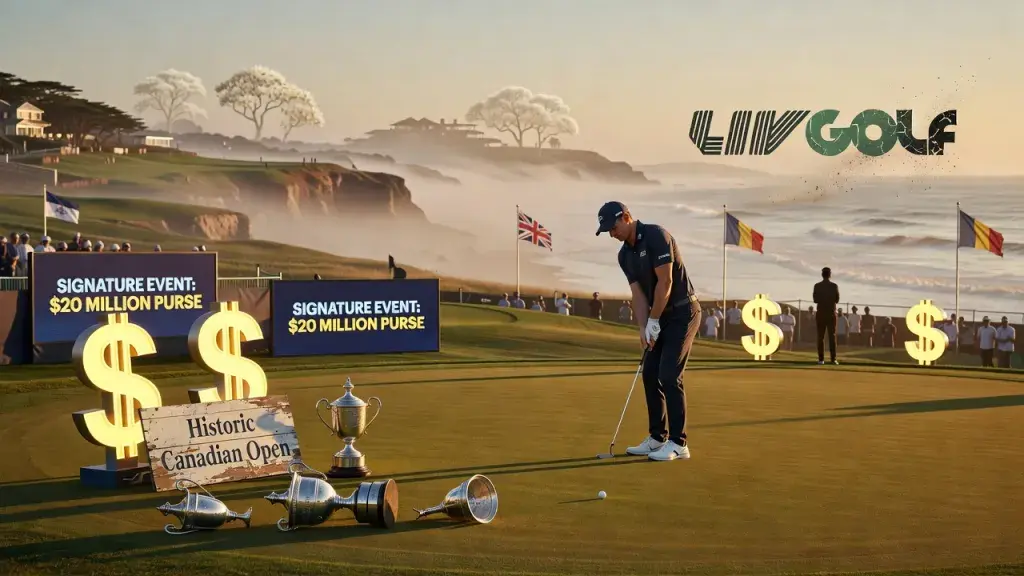
The Northern Irishman's comments arrive at a significant juncture for professional golf. LIV's future has been thrown into doubt after Saudi Arabia's Public Investment Fund - which had committed an estimated five billion dollars to the venture - announced it would cease financing the league at the end of the year. That development has shifted the balance of power back toward the established tours, but not before the PGA Tour had already undergone sweeping structural changes: eight Signature Events with reduced fields and prize funds of 20 million US dollars apiece were created to retain top talent, and a controversial two-tier ranking system was introduced. Across the wider sporting calendar, just as events like the utr pro tennis series women betting markets reflect how new formats reshape competition hierarchies at every level, golf's own restructuring is now being tested for its long-term coherence.
The Cost of the Arms Race
"It's funny as they've done all this work and you start to realise that the way the tour was before LIV came along was actually pretty good," McIlroy said. "It was a pretty good structure, and everything sort of worked pretty well." He acknowledged the emergency logic behind the response - inflating prize funds and tightening fields was necessary to stop the talent drain - but argued that those measures have created a financial benchmark that many traditional tournaments simply cannot meet. "I just think there's going to be certain events that might lose their stature if a sponsor doesn't pony up 30 million dollars," he added, "so that's the tough thing."
His specific concern centred on the Canadian Open, a tournament with deep roots in professional golf's calendar, which he warned could be relegated to the proposed Track 2 tier. Under the new classification system, events that do not meet the elevated sponsorship thresholds would sit in a secondary tier that McIlroy described bluntly as "a glorified Korn Ferry event" - a reference to the PGA Tour's developmental circuit. The implication is stark: prestige built over decades could be erased not by competition on the course, but by a failure to secure commercial backing inflated by a rivalry that may now be winding down.
A European Wave Arrives at Shinnecock
Against that backdrop of institutional turbulence, McIlroy arrives at the US Open carrying momentum. His Masters triumph at Augusta was followed by Aaron Rai - from Wolverhampton - claiming the US PGA Championship, making this the first time since the Masters was established in 1934 that Europeans have won the opening two majors of the season. McIlroy is seeking a seventh major, which would move him clear of Sir Nick Faldo as the most decorated European golfer in the sport's history. A third major in the same calendar year for European golf would represent something genuinely rare, and the Northern Irishman suggested Shinnecock's test suits players from that part of the world. "I would say this is more a UK/European style of test than certainly the first two majors, so it certainly wouldn't surprise me to see a few players from Europe and the UK in contention," he said.
New York Noise, Different Context
McIlroy's last appearance on Long Island came during September's Ryder Cup at Bethpage, where he and his family were subjected to sustained and well-documented abuse from sections of the partisan home crowd during Europe's victory. He was measured in addressing the contrast. "This is different: the Ryder Cup is us versus them, very partisan, it's just a different beast," he said. "Was it a rough week for me at times? Absolutely. But if that's a price to pay to live the life that I'm living, I'm OK with that." His pragmatism was evident: New York crowds are what they are, and he framed their noise not as an obstacle but as an ingredient in a compelling atmosphere. At Shinnecock, with a major on the line and history within reach, McIlroy will need to harness precisely that energy.