
Real Madrid's World Cup Identity Crisis Ends With Cucurella Signing
Authored by freebet.icu, 18 Jun 2026
When Luis de la Fuente named Spain's 26-man World Cup squad on May 25, the omission that immediately dominated conversation had nothing to do with who was in it. For the first time in living memory, not a single Real Madrid player had been selected. Eight Barcelona players made the cut. Several from Atletico Madrid, Athletic Club, Real Sociedad, Celta Vigo and Osasuna were included. The Bernabeu was left without a representative at the sport's biggest tournament - and the ripple effects went well beyond football.
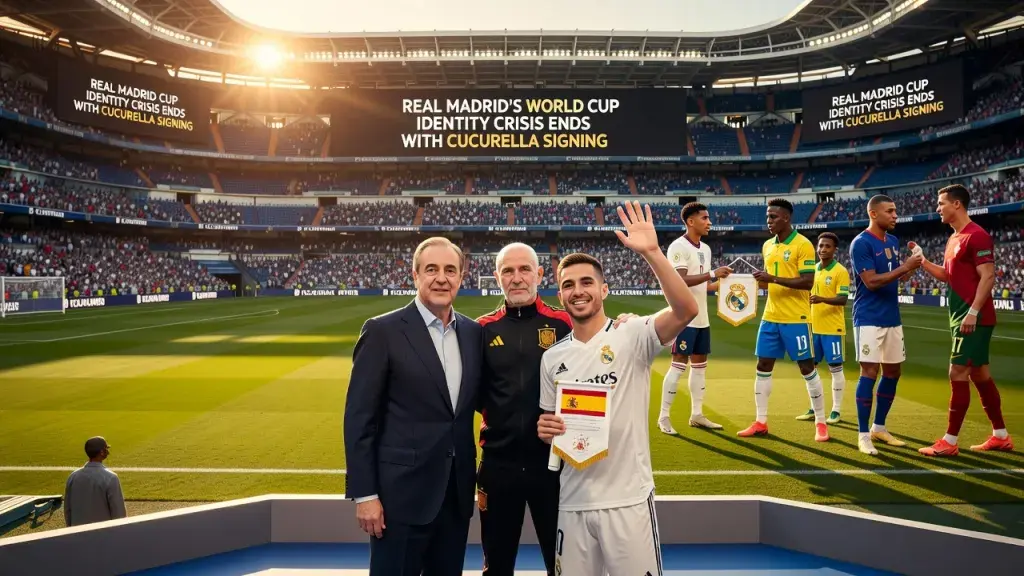
The controversy arrived at a particularly sensitive moment. Madrid were in the middle of a presidential election campaign, and Florentino Perez's challenger, 37-year-old businessman Enrique Riquelme, made the squad exclusion a campaign weapon, promising to sign players who would make Spaniards proud at a World Cup. Perez, who won the June 7 election with a commanding 65 per cent of the vote, did not rise to that bait publicly - a silence that, in retrospect, may have been deliberate. The €60 million signing of Chelsea left-back Marc Cucurella, confirmed just before Spain's 0-0 friendly draw against Cape Verde, has since given Madrid their Spanish World Cup representative. Cucurella, 27, is De la Fuente's first-choice option at left-back and will compete with Alvaro Carreras for a starting role at the Bernabeu next season. For those who enjoy tracking the intersection of club politics and the transfer market - much as fans of field hockey online betting follow team selections and squad dynamics in that sport - the timing of this particular deal carried its own distinct narrative weight. There were no Madrid players in the original squad; now there is one, and a key one at that.
A Complicated History Between Madrid and the National Team
To understand why this episode struck such a nerve, it helps to look back further than the squad announcement. Spain's current golden generation - a cycle that delivered back-to-back European Championships in 2024 and beyond, building on the unprecedented 2008-2012 run of two Euros and a World Cup - has been shaped more by Barcelona's footballing philosophy than Madrid's. That tension has roots going back decades.
In May 2002, Zinedine Zidane's iconic volley at Hampden Park sealed Madrid's ninth European Cup. Barely a month later, Spain were eliminated in the World Cup quarter-finals by co-hosts South Korea. The contrast was not lost on Madrid supporters. Six years later, Spain manager Luis Aragones inflamed the fanbase by dropping club legend Raul entirely from his plans. The 2010 World Cup winning squad leaned heavily on Barcelona: eight of their players were selected, seven of them started the final against the Netherlands. Madrid's key contributors - Iker Casillas, Sergio Ramos, Xabi Alonso - were integral, but the cultural identity of that Spain side belonged elsewhere in the Clasico divide. It would be too strong to claim Madrid fans did not celebrate Spain's successes; of course many did. But for a segment of the support, the Clasico rivalry functioned as a quiet dampener on national pride.
A Global Club, a Global Fanbase - and the Galactico Factor
There is a broader dynamic at work here, one that extends beyond Spain's borders and speaks to how football fandom has evolved in the modern era. Madrid are not simply a club with a domestic fanbase. They are a global brand built around the principle of assembling the very best individual talent, regardless of nationality. That galactico methodology - sign the best, whoever they are, wherever they come from - has shaped not just the squad but the psychology of how supporters engage with the club.
After Perez won re-election, one of the first posts on the club's official social media channels celebrated the players representing their nations this summer: Jude Bellingham for England, Vinicius Junior for Brazil, Arda Guler for Turkey. The message was implicit but clear - Madrid's reach is global, and the club's identity does not depend on the Spanish national team alone. People close to Perez say he has always taken genuine satisfaction in watching Madrid players exchange pennants with one another before international knock-out matches. That is the club's version of a successful international window.
With no Spanish representative initially in the squad, many Madrid supporters turned naturally to the teams of their favourite individual players. Brazil became the obvious first port of call. Carlo Ancelotti - the club's own former manager - is in the dugout, Vinicius Jr is expected to be one of the tournament's most dangerous attackers, and Endrick arrives at the World Cup following a productive loan spell at Lyon, with genuine curiosity surrounding his readiness for the biggest stage. Eder Militao and Rodrygo would almost certainly have joined them had injuries not intervened.
The Ronaldo Factor, Mbappe's Moment, and Bellingham's Test
France offered another compelling narrative for Madrid followers. Kylian Mbappe starred in the 2018 triumph, delivered a famous hat-trick in the 2022 final against Argentina, and arrives at this World Cup with the clearest opportunity yet to define himself as the dominant player of his generation on the international stage. A tournament win would place him in conversations that span eras.
England presents a different kind of investment. Bellingham arrived at the Bernabeu carrying enormous expectation and largely justified it in his first season, before hitting a less consistent patch. A strong World Cup - the kind of sustained, defining performance that tournament football demands - would be a statement of forward trajectory rather than mere confirmation of existing reputation.
Perhaps the most emotionally charged option for a significant portion of the fanbase is Portugal, and specifically Cristiano Ronaldo. The 41-year-old left Madrid eight years ago, yet the attachment many supporters still feel to him is not nostalgia in the passive sense - it is active loyalty shaped by years of shared experience. At this stage of his career, each major tournament could reasonably be framed as a final chapter, and that framing has a way of pulling people back in.
History suggests the World Cup limelight can also introduce new names to Madrid's scouting register. Sami Khedira and Mesut Ozil arrived following 2010; James Rodriguez and Toni Kroos after 2014. The tournament has consistently functioned as the sport's most amplified showcase, and Madrid have never been slow to respond to what they see there.
The Cucurella deal has resolved the headline problem: Madrid will not enter the history books as the first club to go unrepresented in a Spanish World Cup squad. But the episode revealed something real about the club's identity - a fanbase that is genuinely global, individually oriented, and whose relationship with Spanish football's success has always carried a quiet asterisk. For plenty of those supporters, the more intriguing final on July 19 still features Vinicius Jr on one side and Mbappe on the other.