
Tunisia Sack Lamouchi After One Game, Renard Steps In to Salvage World Cup
Authored by freebet.icu, 17 Jun 2026
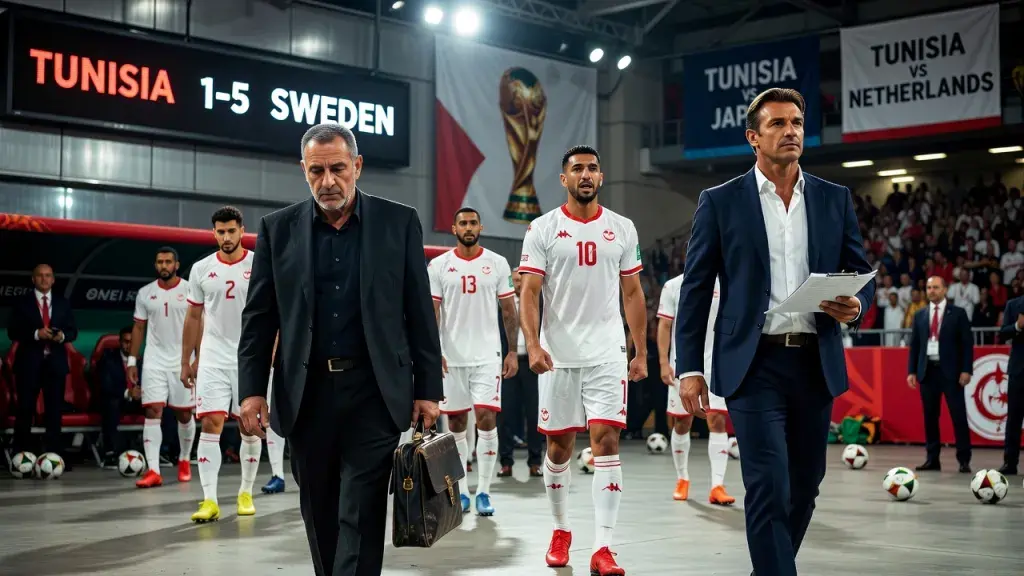
Sabri Lamouchi arrived at the 2026 World Cup determined to live in the present, to set aside a career defined by near-misses and painful exits and simply enjoy the tournament. He lasted barely 48 hours after Tunisia's opening game before the Tunisian Football Federation made its decision: a 5-1 defeat by Sweden was enough, and Lamouchi was gone, replaced by Hervé Renard. It is an extraordinary intervention at a major tournament - and yet, in context, it is not quite the act of pure panic it might first appear.
The speed of the dismissal is what catches the eye, and the manner of it will be debated long after this tournament concludes. In a World Cup that has expanded to 48 teams and where third-placed teams can still progress, losing your opening group game is survivable. Tunisia still have Japan and the Netherlands to face, and a strong result in either could keep them alive. The federation clearly decided that the trajectory of this squad under Lamouchi made a turnaround implausible rather than merely difficult. Off the pitch, football stories dominated discussion in very different corners of the sporting world on the same day - from stadium press rooms to online communities debating everything from World Cup tactics to the dota berserk league - a reminder of how fragmented and vast the global sports conversation has become. But Tunisia's crisis was consuming enough on its own terms.
The numbers that framed Lamouchi's exit tell the clearest story. Across his two most recent fixtures - a 5-0 thrashing by Belgium in the pre-tournament preparation phase and then the 5-1 collapse against Sweden - Tunisia had conceded ten goals. Defender Omar Rekik acknowledged the scale of it plainly after the Sweden game. "Ten goals in two games is crazy," he said. "I want to say sorry to the Tunisian people. This is not good enough." Lamouchi himself called the loss painful and admitted his side had made far too many mistakes, but the language of pride and reaction was no longer enough for those in charge.
A Fragile Foundation: How Tunisia Arrived in Crisis
Lamouchi had only been in post since January, appointed after the federation dismissed Sami Trabelsi - the coach who had guided them through qualification - following a poor Africa Cup of Nations in which Tunisia won just one game and fell to Mali in the round of 16. That pattern of short-termism already said something about the environment Lamouchi was walking into. He compounded the instability by making bold selection calls early: leaving out captain Ferjani Sassi and experienced defender Yassine Meriah, two players with more than 200 caps combined, from his World Cup squad. His reasoning - that he wanted to lower the average age and introduce players who reflected his own vision - was coherent in theory. In practice, the results did not validate the approach. A win over Haiti was followed by a goalless draw with Canada, a 1-0 loss to Austria, and then the Belgium demolition. The 5-1 against Sweden was the culmination of a run that had been deteriorating for months.
History Repeating: Tunisia's Pattern at World Cups
What makes this moment particularly striking is that it has happened before - and to Tunisia specifically. At the 1998 World Cup, the federation dismissed Polish coach Henryk Kasperczak after consecutive defeats to England and Colombia, both by a single goal, with one game still to play. His replacement, Ali Selmi, took charge for the final group game against Romania, then was himself sacked immediately afterwards. Kasperczak was one of three coaches to lose their jobs mid-tournament in 1998: Carlos Alberto Parreira, four years removed from winning the World Cup with Brazil, was let go by Saudi Arabia, and Cha Bum-kun departed as South Korea manager under similar circumstances. The key distinction between those cases and this one is timing: in 1998, all three coaches were dismissed after their teams had already been eliminated with two defeats. Lamouchi's sacking comes with two games still remaining and qualification still a mathematical possibility.
Renard's Return and What Comes Next
The appointment of Hervé Renard to replace him carries its own layers of context. Renard, one of the most decorated coaches in African football, was himself sacked by Saudi Arabia in April, making this something of a mutual World Cup rescue operation. He knows the pressures of tournament football in the Arab world, and he has the profile and authority to command immediate respect in a dressing room that, by the players' own admissions, needs serious reordering. Whether he can shift the dynamic inside a squad that has just conceded five goals against Sweden - and whose defensive vulnerabilities against Belgium were already on the record - is the real question. Games against Japan and the Netherlands offer limited margin for optimism, but stranger things have happened in a tournament of this size and format. For Lamouchi, the symmetry is brutal. He spoke the day before the Sweden game about not thinking of the past, not looking to the future, just enjoying the present. As present moments go, this one was mercilessly brief.