
FIFA Rankings Shift as Brazil Enter Top Five After Portugal's Opening Stumble
Authored by freebet.icu, 18 Jun 2026
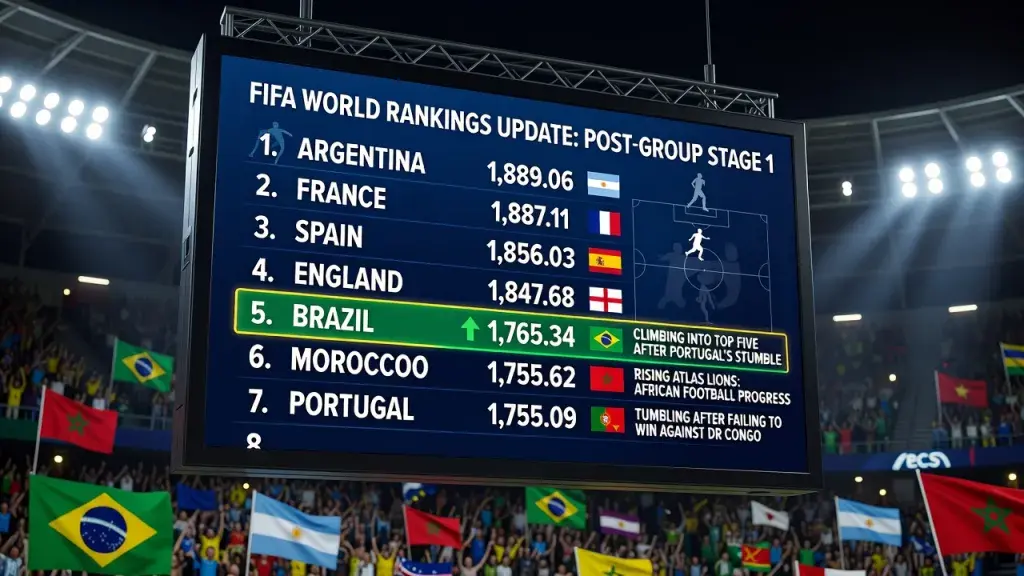
The FIFA World Rankings have been reshuffled following the conclusion of the first round of World Cup group stage matches, with several notable movements altering the top ten. Brazil climbed one place into fifth position on 1,765.34 points, benefiting directly from Portugal's surprise failure to win their opener against DR Congo on Wednesday. The changes carry more than cosmetic significance - the ranking serves as the final tiebreaker in the group stage should all other criteria remain level.
Portugal bore the brunt of the first-round results, tumbling two places to seventh on 1,755.09 points after their stumble in what was widely expected to be a straightforward fixture. That single result cost the Iberian side dearly in the standings, with Morocco climbing above them to claim sixth place on 1,755.62 points - a narrow but meaningful gap. The Atlas Lions' continued rise up the FIFA table reflects the sustained progress African football has made at the elite level in recent years, a trend that goes well beyond a single tournament. Interestingly, for readers who follow a wide range of competitive sports markets, the kind of real-time ranking volatility seen here is not unlike what seasoned observers track through platforms such as a bkfc betting app, where live standing shifts can alter the competitive landscape just as quickly.
France moved into second place on 1,887.11 points, overtaking Spain, who were held to a draw by Cape Verde and now sit third on 1,856.03 points. That result for Luis de la Fuente's side was one of the more eyebrow-raising outcomes of the opening round, and the ranking slide, while modest, underlines how tightly contested the upper tier of international football currently is. Argentina remain unchallenged at the summit on 1,889.06 points, with England fourth on 1,847.68. Germany also gained ground, moving above Belgium to ninth on 1,743.54 points, with Belgium dropping to tenth on 1,733.93.
The Tiebreaker Rule and What It Means in Practice
It is worth clarifying precisely how the FIFA ranking interacts with the group stage. The ranking functions solely as the last resort tiebreaker - applied only after goal difference, goals scored, head-to-head record, and fair play points have all failed to separate teams. Given how rarely it comes into play, the practical effect of these mid-tournament fluctuations is limited. Critically, FIFA has confirmed that it is the pre-tournament ranking that applies, not the updated one. Under that pre-tournament table, Brazil were placed sixth and ahead of Morocco - a detail that could matter in a theoretically tight group scenario, even if the circumstances that would bring it into effect remain unlikely.
Updated FIFA Top Ten After Round One
- 1. Argentina - 1,889.06 points
- 2. France - 1,887.11 points
- 3. Spain - 1,856.03 points
- 4. England - 1,847.68 points
- 5. Brazil - 1,765.34 points
- 6. Morocco - 1,755.62 points
- 7. Portugal - 1,755.09 points
- 8. Netherlands - 1,749.20 points
- 9. Germany - 1,743.54 points
- 10. Belgium - 1,733.93 points
Broader Picture: Africa Rises, Europe Shuffles
Morocco's position in sixth is the most telling detail in this updated table. The Atlas Lions' progression from outsiders to consistent top-ten presences in the FIFA rankings marks a structural shift in African football's global standing, not a fluke run. Their 2022 World Cup semifinal appearance was not an anomaly - it was the clearest expression yet of a footballing infrastructure and tactical identity that has been built deliberately over time. Portugal's dip to seventh, sandwiched between Morocco and the Netherlands, serves as a reminder that the European mid-tier can no longer treat African opposition as a guaranteed source of points. Brazil, meanwhile, will take quiet satisfaction from re-entering the top five, even if the manner - benefiting from a rival's misfortune - is hardly the statement Dorival Júnior's squad would have chosen. The rankings will continue to shift as the group stage plays out; the football itself will ultimately determine whether these numbers reflect genuine momentum or statistical coincidence.